Tuesday, April 7, 2020

Science - Home Learning - Easter Holidays

How clean are your hands? I want you to carry out an experiment...

After spending some time at the playground, football field, or in the garden, it can be easy to see the dirt on our hands.

What you can’t see are the invisible-to-your-eye germs that gather on your hands throughout the day. To help you see the effect those germs have, give this this eye-opening experiment a try.

HAND HYGIENE EXPERIMENT

What you’ll need:

Three slices of bread
Three resealable bags
Instructions:
  1. Label each of the three bags:
  • Control
  • Dirty
  • Clean
2. Place one slice of bread in the “control” bag without touching it. You can use clean tongs, or turn the resealable bag inside out and use it like a glove to get the slice inside. Seal the bag.

3. Remove a second slice of bread and touch the bread with unwashed hands. Place the bread in the bag and seal it.

4. Wash your hands with soap and water.

5. Take a third slice of bread and touch the bread with freshly-washed hands. Place the bread in the bag and seal it.

6. Take all three sealed bags and put them in a cool, dry place.

Look at the bread daily and write down your observations, but do not take the bread out of the bags. In a few days, mold should start to appear. 
What slice of bread gets moldy first? 
Which grows the most mold? 
Which grows the least? 

If mold starts to appear, take a ruler and measure it and record your observations. You can even draw a picture of the bread each day, or keep a photo diary by taking pictures of the bread each day to watch the changes over time.


Literacy - Home Learning - Easter Holidays

Premier League Writing Stars poetry challenge

The National Literacy Trust is running a poetry competition and I want you to enter! Go on, give it a go!

This is what they have to say:

We want you to join in the challenge and write a poem all about ambition. The challenge is open to everyone! Use our films, model poems and top tips to get started. There are useful resources below that will support and inspire you to create your own poems!

Send in your poems to plprimarystars@premierleague.com or share on Twitter @PLCommunities with the hashtag #PLPrimaryStars.


You will need to create a free account to access all of the resources for the competition. 

Use the activities here to think about what the word ambition means to you and learn about what makes a great poem. This is a great way to help get you started with writing your own poem!

French - Home Learning - Easter Holidays


Guided Reading - Home Learning - Easter Holidays

This weeks learning is a comprehension activity. There are 6 different levels of challenge, so choose the one that challenges you! Read the text and then answer the questions in your exercise book.

Red Challenge


Blue Challenge


Orange Challenge


Green Challenge


Purple Challenge


Pink Challenge


Maths - Home Learning - Easter Holidays

Hi everyone,

Here are some home learning maths tasks for you to tackle over the holidays:

Mild - Week 3


Spicy - Week 3
https://whiterosemaths.com/homelearning/year-5/
  • Click on the set of lessons for year 5.
  • Watch the video.
  • Find a calm space where you can work for about 20-30 minutes.
  • Use the video guidance to support you.
Lesson 1 - Step 1 - Adding decimals within 1
Lesson 2 - Step 2 - Subtracting decimals within 1
Lesson 3 - Step 3 - Complements to 1
Lesson 4 - Step 4 - Adding decimals - crossing the whole
Lesson 5 - Step 5 - Adding decimals with the same number of decimal places

Maths Challenge:

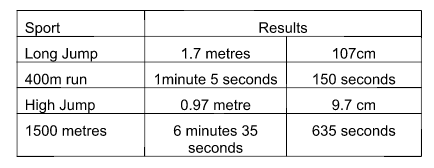
As part of World Health Day, Year 5 and Year 6 have held a mini sports day. Below is John's score card.


Can you spot the mistakes? Explain what he has done correctly and incorrectly?

Ready for a Challenge?

Use the information below to work out the winning scores of the sports day:

John was:
  • .035 metres short of the winning long jump
  • 8 seconds slower than the winner of the 400m run
  • 43cm less than the winner of the high jump
  • 40 seconds slower than the winner of the 1500 metres


Monday, March 30, 2020

David Walliams - World's Worst Children stories - 11:00am everyday


David Walliams is reading one of his World's Worst Children stories every day at 11.00. If you can access this, it would be a lovely break from working (or playing!).

https://www.worldofdavidwalliams.com/elevenses/

Science - Home Learning - Monday 30th April 2020


Instant Ice Cream - Properties and changes of materials


Ice cream is basically droplets of fat from milk suspended in millions of tiny crystals of ice, fluffed up with tiny pockets of air.

This activity shows you how to make the right mixture, then make it cold enough to create those ice crystals without the aid of a freezer. It also reveals how salt and ice make a chilling combination.

What’s the science?

Pure water freezes at 0 degrees Celsius. Add salt and the freezing point drops by a few degrees. When you add salt to the ice in the outer bag, the ice (at 0°C) is now above its freezing point – so it begins to melt. Melting requires energy, and in this case that energy comes from the flavoured milk mixture in the inner bag. Ice crystals start to grow in-between the tiny globules of fat in the milk and bubbles of air, causing the milk to freeze and change state from a liquid to a solid.


Believe it or not, you can make ice cream without a freezer.


Think and talk about…
  1. What do you see happening to the ingredients?
  2. What do you think the salt is doing? 
  3. How could you find out more?
  4. How does the finished product compare with shop-bought ice cream? 
Investigate…
  1. Can you make the ice cream freeze faster?
  2. Try altering the amount of salt or how much you shake the mixture.
  3. Try different ingredients – do they behave in the same way? 


Computing: Vector drawing

Year 5 have started to create vector drawings. They have learnt how to use different drawing tools to help them create images. We now recogn...